
As Ergon Network phases out legacy demand tariffs and introduces new pricing structures from 1 July 2025, large electricity customers face a critical choice: remain on the anytime demand small tariff (DST) or transition to the time-of-use demand network tariff (LTOUD).
These changes apply to all customers connected to the Ergon distribution network — regardless of which electricity retailer they buy energy from.
Each network tariff is designed to encourage different usage behaviours, and the choice can have a major impact on overall energy costs. This blog focuses solely on comparing EDST and LTOUD, outlining the structural differences between the two and helping you understand which tariff may be more appropriate for your business based on its operating hours and demand profile.
Network Tariff Comparison
Below is a summary of the two tariffs:
| Network Tariff | EDST | LTOUD |
|---|---|---|
| Tariff Type | – One monthly demand charge. – Demand charge has a 35kVA free allowance. – Anytime demand and energy structure – Includes daily supply | – Two monthly demand charges – Time-of-use demand and energy structure – Varies by time of day (peak, shoulder, off-peak) – Includes daily supply |
| Charging Windows | – Flat charging window (anytime) | – Peak window: 5 pm – 8 pm weekdays – Off Peak window 11 am – 1 pm daily – Shoulder window: All other times except for Off Peak |
Below is a table showing the rates for each tariff:
| Charge Description | Unit | DST | LTOUD |
|---|---|---|---|
| Demand-free threshold | N/A | 35 kVA | N/A |
| Peak usage | kWh | $0.0229 | |
| Shoulder usage | kWh | $0.0473 | |
| Off-peak usage | kWh | $0.0229 | |
| All usage | kWh | $0.0420 | |
| Anytime Demand | kVA | $21.75 | |
| Peak demand charge | kVA | $21.75 | |
| Shoulder demand charge | kVA | $8.05 | |
| Supply charge | Daily | $52.24 | $47.96 |
Which tariff is best for my business?
To determine which tariff is most suitable for your site, consider the examples outlined below.
Please note that the comparisons provided focus solely on demand charges for simplicity.
If a comprehensive review is undertaken, we will conduct a detailed assessment of all cost components to ensure the most accurate outcome.
Example 1: Manufacturing Facility

*The above graph shows a sample manufacturing load profile with the peak demand window highlighted in red.
- Operates from 6 AM to 4 PM
- Maximum demand of 380kVA occurring at 4:30 AM, curtailing down to 20kVA from 5PM onwards.
- Best fit:
| Demand Comparison | Demand | 44A ($/kVA) | 44A (Cost) | 50B ($/kVA) | 50B (Cost) |
|---|---|---|---|---|---|
| Anytime Demand (-35kVA) | 345 | 21.746 | $7,502 | – | – |
| Peak Demand | 20 | – | – | 21.746 | $435 |
| Shoulder Demand | 380 | – | – | 8.046 | $3,057 |
| Monthly Demand Cost | – | – | $7,502 | – | $3,492 |
| Monthly Cost Movement | – | – | – | – | $(4,010) |
| Annual Cost Movement | – | – | – | – | $(48,120) |
Example 2: Hospitality Venue (e.g. a Pub)
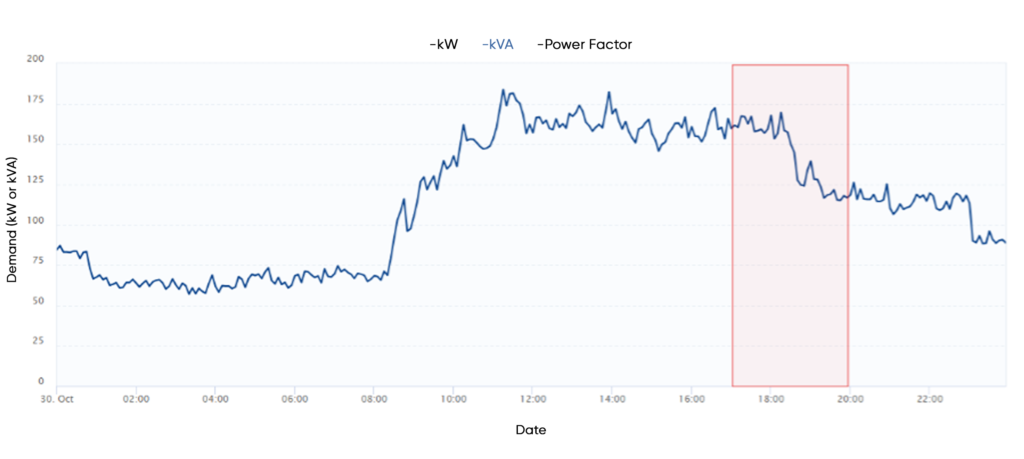
*The above graph shows a sample hospitality venue load profile with the peak demand window highlighted in red.
- Operates 12 hours per day with a constant refrigeration load.
- Demand peaks to 185kVA at 11AM and sustains until 6PM, tapering off slightly to 170kVA
- Best fit:
| Demand Comparison | Demand | DST ($kVA) | DST (Cost) | LTOUD ($kVA) | LTOUD (Cost) |
|---|---|---|---|---|---|
| Anytime Demand (-35kVA) | 150 | 21.746 | $3,262 | – | – |
| Peak Demand | 170 | – | – | 21.746 | $3,697 |
| Shoulder Demand | 185 | – | – | 8.046 | $1,489 |
| Monthly Demand Cost | – | – | $3,262 | – | $5,185 |
| Monthly Cost Movement | – | – | – | – | +$1,923 |
| Annual Cost Movement | – | – | – | – | +$23,081 |
Need Help Comparing Tariff Options?
Choosing between TOU and anytime demand tariffs isn’t just about price — it’s about matching your operational behaviour with the tariff structure. We help C&I customers analyse their interval data, model different tariff outcomes, and identify opportunities to shift demand and save.
Contact our team for a tailored tariff review to prepare your sites for the July 2025 transition.
Get advice from our Energy Management Consultants

Ewen Beard
Sales Manager
Get in Touch
Feel free to call or e-mail us. Or just fill in the form below and we’ll contact you for an obligation-free discussion.
Are you ready to save on business energy costs?
Get Started
Leading Edge Energy is proud to be a signatory of the National Customer Code for Energy Brokers, Consultants and Retailers.